ANNARITA AVERSA: THE ART OF LISTENING
16.06.2026 LE SIRENUSE

After training in Rome and Barcelona, Aversa went on to work for a series of leading firms in the Netherlands, Spain and Italy. She founded the Architetti Artigiani Anonimi studio in Amalfi in 2013, adding a Milan office in 2028. The studio’s ongoing research project Vademecum – a manual of traditional Amalfi Coast building techniques and materials – was selected for the Italian pavilion at the 2025 Venice Architecture Biennale.
Born in Amalfi, Aversa is a 360-degree architect: as well as designing private residences, hotels and commercial properties, she also creates furnishings and fittings for many of her projects, some of which become limited standalone product lines. A vase from her ceramic collection Proporzione Mediterranea, inspired by the vaulted houses of the Amalfi Coast, can be admired at Le Sirenuse Mare.
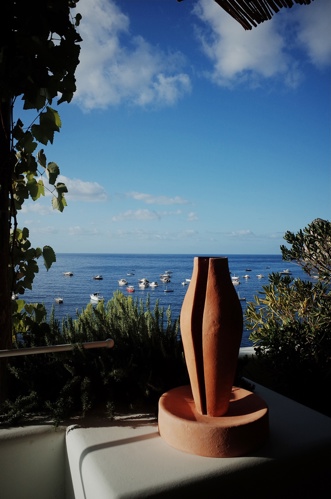
Aversa describes the Le Sirenuse Mare project as “an act of listening—to the place, its silent history, and the present time. It is a temporary architecture that renounces emphasis in favour of measure, restoring to the landscape a new possibility of being inhabited”.
The interview that follows was recorded at the architect’s remarkable family property in Conca dei Marini. Incorporating an ancient coastal watchtower among other buildings, it ascends a hill so steep that a cabinovia was installed here many years ago – one of only three private cable cars in the Mediterranean. Aversa describes her Amalfi home as a place of “roots, emotions and inspirations”.

“The site where Le Sirenuse Mare stands today was quite barren when we arrived. So it was important to mend the caesura in the landscape, to give it proportion and balance, and to use architecture and vegetation to create a visual continuity with the adjacent properties.
“I liked the idea of creating a kind of stage set in the midst of the landscape. I wanted to give the impression that you’re looking at something that has been built for a show or a theatrical performance. I was aiming for a lightness of touch, a project that does not leave a scar, one that is here today but might be gone tomorrow.

View
“Paolo’s work is rich in its simplicity. He’s in his eighties now but I think his mature work is his best. Without the landscape he created here even the most amazing architectural project wouldn’t have made any sense, it would have stood out too much, it would have been too showy and at the same time somehow arid. Architecture needs to know its limits, especially in places like this. It’s one thing designing a building in Milan, quite another designing a beach club that is dominated by sky, sea and nature. With his intuition of creating an irregular planting scheme, Paolo Pejrone made the space appear natural and spontaneous.
“There are two faces to the beach club. When you approach from the sea, the first thing you see are the open lower terraces, which are appealing and contemporary. There are those jaunty white and blue cabins with their arched roofs, there’s Rose’s Bar, there are sunloungers, beach umbrellas and cabanas, lanterns and sculptures – it’s fun and inviting.

“Then when you go up the steps towards the restaurant area, suddenly you’re in a green oasis that you never want to leave. Here, relaxed elegance is the keyword. The idea was to create a series of small living rooms, to reproduce in an entirely outdoor context the spirit of Le Sirenuse which feels very much like a house, very intimate and human-scale. The last thing you want is to be dazzled by design. Paolo’s word for the effect we were searching for was ‘un verde strusciante’ – a green world that you find yourself drawn into from the exposed lower terraces, one that you literally brush up against.

View
“I’m passionate about the traditional architecture of the Amalfi Coast. At Le Sirenuse Mare, we made the pergolas out of the same chestnut wood poles or pertiche that lemon farmers use to create the frames that protect the trees in winter. The drystone walls of the terraces were laid entirely without cement by expert artisans. The cabins have the kind of barrel-vaulted roofs that you can still see in older houses. For the design of the furnishings, on the other hand, I looked to a more recent tradition – the dolce vita years of the 1950s and 1960s.
“In my ceramic sculptures, like the one you can see on the corner of the restaurant terrace, I explore forms from the Amalfi Coast’s vernacular architecture. For me there’s not really any difference between designing furniture, sculptures and buildings, or between designing exteriors and interiors. It’s all architecture”.
Photos of Annarita Aversa © Roberto Salomome
Le Sirenuse Mare photos © Stefan Giftthaler
Stay up to date


A member of