FESTIVE DINING, LE SIRENUSE STYLE
20.11.2026 EMPORIO SIRENUSE

We turned to Le Sirenuse’s executive chef Gennaro Russo for advice on lightening up and Positano-ising that big celebratory meal. Gennaro’s solution was geniale (a lovely Italian word that wraps up ‘smart’ with ‘ingenious’). He suggested retaining the central roast bird element of the North American and British traditions, but making it chicken rather than turkey, and accompanying it with some Neapolitan festive classics – among them spaghetti alle vongole and two desserts that bake in all the deliciousness and theatricality of this part of southern Italy: la pastiera and la torta caprese.
“In my part of the world”, Gennaro explains, “we certainly know how to eat, but festive dining is not about a serving an endless series of dishes, it’s about offering tempting bites in a beautiful setting. It’s a performance, a ritual that centres on family ties and affection, as much as it is a meal”.

With this in mind, we set about translating the festive mood of Naples and the Amalfi Coast into a table setting. And we brought in talented interiors and lifestyle photographer Joanna Maclennan to document the result.
Central to this tablescape are the hand-painted ceramic plates of Emporio Sirenuse’s Suzani Collection. The late Franco Sersale, one of four siblings who in 1951 turned their family villa in Postiano into a small hotel they called Le Sirenuse, was a keen and discerning collector. Among his passions were the antique embroidered rugs from Central Asia known as Suzanis, some of which can be admired as wall hangings in the hotel’s rooms and corridors.
The swirling motifs of these folk-art textiles were the inspiration for a collection of hand-embroidered cushion covers that launched the newly created Emporio Sirenuse brand back in 2013. Eight years later, the cushion covers were joined by a line of bold, striking plates and bowls crafted in the Amalfi Coast ceramics town of Vietri sul Mare.

Infusing the joyous summer energy of Positano with the mysterious allure of the Silk Road, this collection has proven to be one of the Emporio’s most popular lines. We’ve always believed it’s as much at home on a festive table in a wintery landscape as it is on a beachside veranda.
To bring some southern Italian atmosphere and colour to your festive table, alongside the pumpkins, corn cobs and gourds, consider sourcing some pomegranates and arranging them both whole and sliced through to reveal the glistening crimson seeds (careful however – pomegranate juice stains, so maybe nestle the sliced fruits in bowls). Whole and sliced figs, fresh or dried, are another typically Italian touch. And no festive setting in Italy would lack a bowl of fresh, bright mandarins, tangerines or clementines.

Consider serving a simple salad of thinly-sliced fennel and oranges, dressed with good olive oil, sea salt and plenty of black pepper, as a fresh, appetite-building starter. Then move on to the spaghetti alle vongole – the recipe for which can be found here.

View
We trust to you to find your favourite glazed roast chicken recipe. Gennaro suggests serving it up with traditional roast potatoes but adding a Neapolitan touch by making the accompanying greens scarola, or escarole.
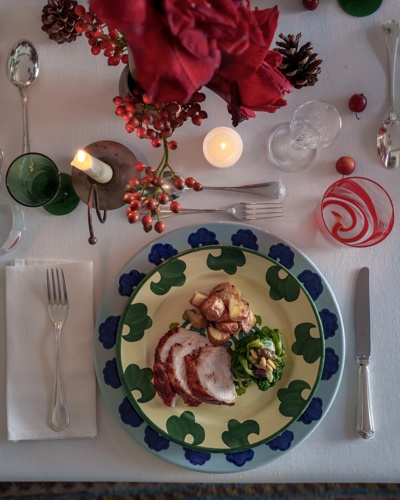
You can find the classic scarola recipe below. It’s taken from Alice (Anchovy) the upcoming third book in Le Sirenuse’s ‘Ingredients of the Amalfi Coast’ series, which will be available exclusively in the hotel in 2027.
The recipe for torta caprese can be found here – it was the first recipe we ever posted in the online Le Sirenuse Journal, back in 2013! And here’s how to make that most Neapolitan of deep-dish sweet pies, la pastiera.
Shop Emporio Sirenuse’s Suzani ceramics collection here.
Buone feste! – Happy Holidays – and don’t forget to pay us a visit in 2027, when the America’s Cup yacht race comes to Naples – the first Italian host city in the competition’s 175-year history.
Photos © Joanna Macelenna
RECIPE: Neapolitan-style escarole
serves six as a side dish
2 escaroles
6 anchovies preserved in oil
30g (1oz) pitted Taggiasca olives
1 tablespoon salt-preserved capers, well rinsed
1 tablespoon sultanas/raisins
1 tablespoon pine nuts
2 peeled garlic cloves
Olive oil, salt and pepper

Remove the toughest outer leaves from the escaroles and discard. Separate the others from the central stalk, rinse well and dry. Boil a little water and pour it over the raisins/sultanas ten minutes ahead of time to plump them up; squeeze before use to remove the excess water.
Glug a generous double spiral of good olive oil into a wide, heavy-bottomed pan or large casserole, place on a medium heat, then add the garlic cloves, olives, sultanas/raisins and pine nuts. Adjust the heat and stir so the anchovies dissolve gently without spitting, adding more oil if needed. Remove the garlic cloves when they have taken on colour.
Add the escarole leaves to the pan, cover and raise the heat slightly. Some add half a cup of water at this stage to start the leaves off, but they will run abundant liquid once the heat and steam do their work, so use your judgement. Remove the cover after five minutes and continue cooking on a medium to low heat. The escarole is ready when it has absorbed most or all of the cooking water – probably 15 to 20 minutes in all. When adjusting for salt, bear in mind that the anchovies and the capers will have done some of the work for you.
Artwork © Anouk (Anna Monaco)
Stay up to date


A member of